The most enjoyable online games are not always the ones with the biggest budgets, famous publishers, or massive marketing campaigns. Some of the games players remember most are built around one clear idea, one unusual mechanic, and a creator who has the freedom to follow that idea without layers of corporate approval.
That is one reason solo-created games are gaining so much attention in 2026. They often feel focused, experimental, and surprisingly personal. Instead of trying to appeal to every type of player, they usually concentrate on one satisfying experience and make it easy to understand within the first few minutes.
This does not mean every game made by one person is automatically better. Solo development has challenges, including limited time, smaller teams, and fewer resources for testing. However, when a solo creator finds the right concept, the result can feel more original than a carefully designed product built around familiar formulas.
For players searching for free online games, browser games, or fresh experiences to enjoy between larger releases, solo-created titles are worth watching.
Why solo creators can make games feel more original
Large studios have advantages. They can create detailed worlds, produce cinematic trailers, and support games for many years. However, large productions also involve more departments, more deadlines, and more decisions based on market research.
A solo creator can often move in a different direction.
If the creator has an unusual idea for movement, progression, physics, or level design, they may be able to build a prototype quickly and test whether the idea is genuinely fun. They do not necessarily need to make the concept fit an existing franchise or a proven commercial category.
That freedom can lead to games with:
- A more distinctive central mechanic
- Shorter paths between idea and playable version
- Less unnecessary content
- More unusual visual styles
- More direct experimentation
- A stronger sense of personality
This focus is especially useful for Online Games, where players often decide within minutes whether they want to continue. A game does not need a huge opening cinematic if its main idea is immediately enjoyable.
One strong idea can be more memorable than dozens of features
Many modern games include enormous maps, complicated progression systems, multiple currencies, seasonal events, and long tutorials. These features can be impressive, but they can also make a game feel like work before the fun begins.
Solo creators often have to be selective. They may not have the time or resources to add everything, so the game is built around the feature that matters most.
That might be:
- Building something creative
- Surviving increasingly difficult challenges
- Mastering a difficult movement system
- Competing for a better score
- Creating funny physics moments
- Repeating a short gameplay loop until it becomes satisfying
A focused idea is easier for players to understand and easier to share. When someone tells a friend about the game, they can explain the appeal in one sentence.
This matters for people who want to play with friends online. A simple game can be much easier to recommend than a title that requires a long explanation before anyone understands what makes it fun.
Solo games often respect the player’s time
Not every player wants to spend hours learning a complicated system. Sometimes you want a quick game during a break, a challenge after school, or something entertaining without downloading a large file.
This is where solo-created browser experiences can be particularly appealing. Their sessions are often easy to start and stop. You can play for five minutes, return later, and still understand what you are doing.
The best Online Free Games usually provide value without demanding a major commitment. They may offer:
- Immediate access to the main gameplay
- Clear controls
- Short rounds or levels
- Progress that is easy to understand
- A challenge that increases naturally
- Enough variety to encourage another attempt
That structure is ideal for casual players. Casual games do not have to be shallow. A simple control scheme can still support deep skill, difficult decisions, and long-term improvement.
A personal style can make a game stand out
Solo creators are often closely connected to every part of their project. They may design the gameplay, choose the art direction, write the interface text, create the sound style, and decide how the game should feel.
That personal involvement can give a game a stronger identity.
The visuals might be minimalist instead of realistic. The animations might be exaggerated. The menus might be unusual. The sound effects might make a simple action feel much more satisfying.
These details create a personality that is difficult to copy. Even when the game uses a familiar genre, its mood can feel different because the creator has made decisions based on personal taste rather than trying to match a market trend.
This is one reason players often discover small games through recommendations, short clips, or social posts. A distinctive moment can communicate the entire appeal better than a long advertisement.
Small creators can react to player feedback faster
A solo creator may be able to notice a problem and make a change without waiting for several internal teams to approve it. Feedback does not always lead to an immediate update, but the distance between the player and the person making the game can be much shorter.
That can improve the experience in practical ways.
Players may point out that a level is too difficult, a control feels uncomfortable, or an important instruction is unclear. A creator who is closely involved with the game can decide whether the issue is worth fixing and adjust the design accordingly.
This relationship can also make updates feel more meaningful. Instead of adding content simply because a calendar says it is time for an update, a creator may focus on improving the part of the game players actually use.
Of course, players should not expect every solo developer to respond to every comment. Small teams have limited time, and healthy feedback should remain specific and respectful.
Why a smaller game can feel less exhausting
Many players are experiencing fatigue from games that constantly demand attention. Daily rewards, limited-time events, battle passes, notifications, and frequent purchases can turn entertainment into another obligation.
Solo-created games often feel refreshing because they may be built around the play session itself. The goal is not always to keep you logged in for months. Sometimes the goal is simply to make the next round enjoyable.
That difference can make a game feel more honest.
A good small game does not need to pretend that every session is part of a huge lifestyle. It can provide a challenge, a laugh, a creative outlet, or a satisfying sense of progress and then let you leave when you are finished.
This is especially useful for players who want variety. Instead of committing to one massive title, you can try several different games and find the ones that match your mood.
What players should look for in solo-created games
The label “solo-created” can attract attention, but it should not be the only reason you try a game. The important question is whether the experience delivers something enjoyable.
Before spending time with a new title, consider:
Is the main mechanic easy to understand?
The game should communicate what you are doing quickly. Clear goals and responsive controls are more important than a complicated introduction.
Does the challenge feel fair?
A difficult game can be satisfying when failure teaches you something. If success depends mostly on confusing instructions or unpredictable controls, the experience may become frustrating.
Is there a reason to continue?
Progression does not need to involve dozens of systems. New levels, better scores, unlockable items, creative possibilities, or improved personal skill can all provide motivation.
Does the game have its own identity?
Look for a visual style, mechanic, or tone that feels distinctive. A familiar genre can still be worthwhile if it presents the idea in a fresh way.
Can you play it comfortably?
Check whether the controls work well on your device and whether the game suits the amount of time you have available. Convenience is part of quality.
A focused platformer example
MEGA OBBY is described as a vibrant 3D platformer with 40 obstacle courses built around precision, timing, and patience. Players collect gems, unlock pets, and progress through stages filled with jumps, traps, and moving platforms. The supplied summary presents it as a classic obby experience with substantial content for players who enjoy steadily increasing difficulty. It does not independently confirm that the game was made by a solo creator, so that detail should be verified before presenting it as a solo-developed title.
What makes this type of game attractive is its clear promise. Players know they are entering a platforming challenge where progress depends on improving movement and learning each course. The structure is easy to understand, but the stages can still create meaningful difficulty.
That combination is common in successful smaller games. The controls may be simple, while the decisions required to succeed become more demanding over time.
How to discover more games from independent creators
Finding enjoyable games is often easier when you use signals beyond the most famous releases. Pay attention to games that have a specific concept, a clear description, or a visual style that immediately communicates what makes them different.
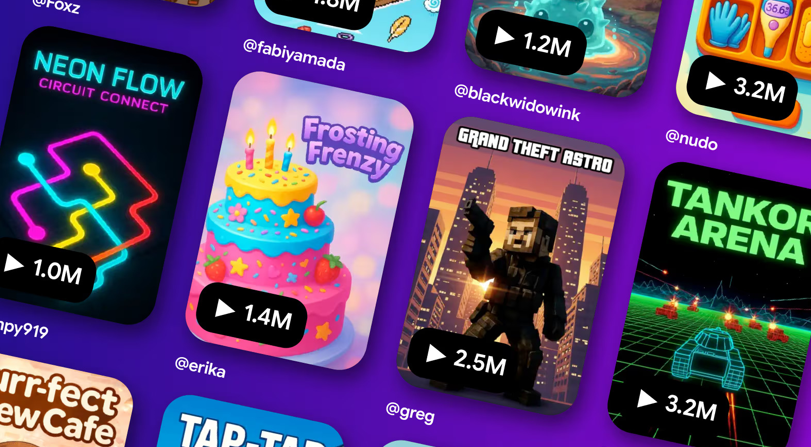
Astrocade’s current homepage includes discovery areas such as Players’ Choice and Trending, along with sections including My Arcade, Create, and Profile. These features can help players browse what is receiving attention on the platform and explore new experiences based on their interests. Individual game features may vary, so check the specific game information before assuming that every title offers the same social or multiplayer options. You can also find promising games by:
- Searching for a mechanic instead of only a genre
- Trying games with unusual titles or concepts
- Saving games that you want to revisit
- Sharing discoveries with friends
- Looking for creators who release multiple experiments
- Giving a small game enough time to reveal its main idea
The goal is not to play everything. It is to find games that offer a clear experience without wasting your time.
Are solo-created games always better?
No. Solo development is not a guarantee of quality. A game can have a brilliant idea but weak controls, unclear progression, or technical problems. Larger studios can also create focused, creative, and deeply personal games.
The real advantage of solo creators is flexibility. They can take risks that may be difficult for a large production to justify. They can build around an unusual idea, keep the scope manageable, and make decisions based on the experience they want to create.
Players should judge the finished experience rather than the size of the team.
If the controls feel good, the challenge is engaging, and the game gives you a reason to play another round, it is doing its job.
See also: Indoor Pizza Nights Made Easy With Electric Pizza Ovens
The most fun online games are not always the biggest ones. Sometimes, they are compact projects built around a simple idea that works immediately. In 2026, players have more ways than ever to discover those experiences, try them without a major commitment, and share the best finds with friends.